Light-debris interception
Temporary or secondary containment under a reviewed source, with inspection and clearance planning.
Start with the overhead hazard
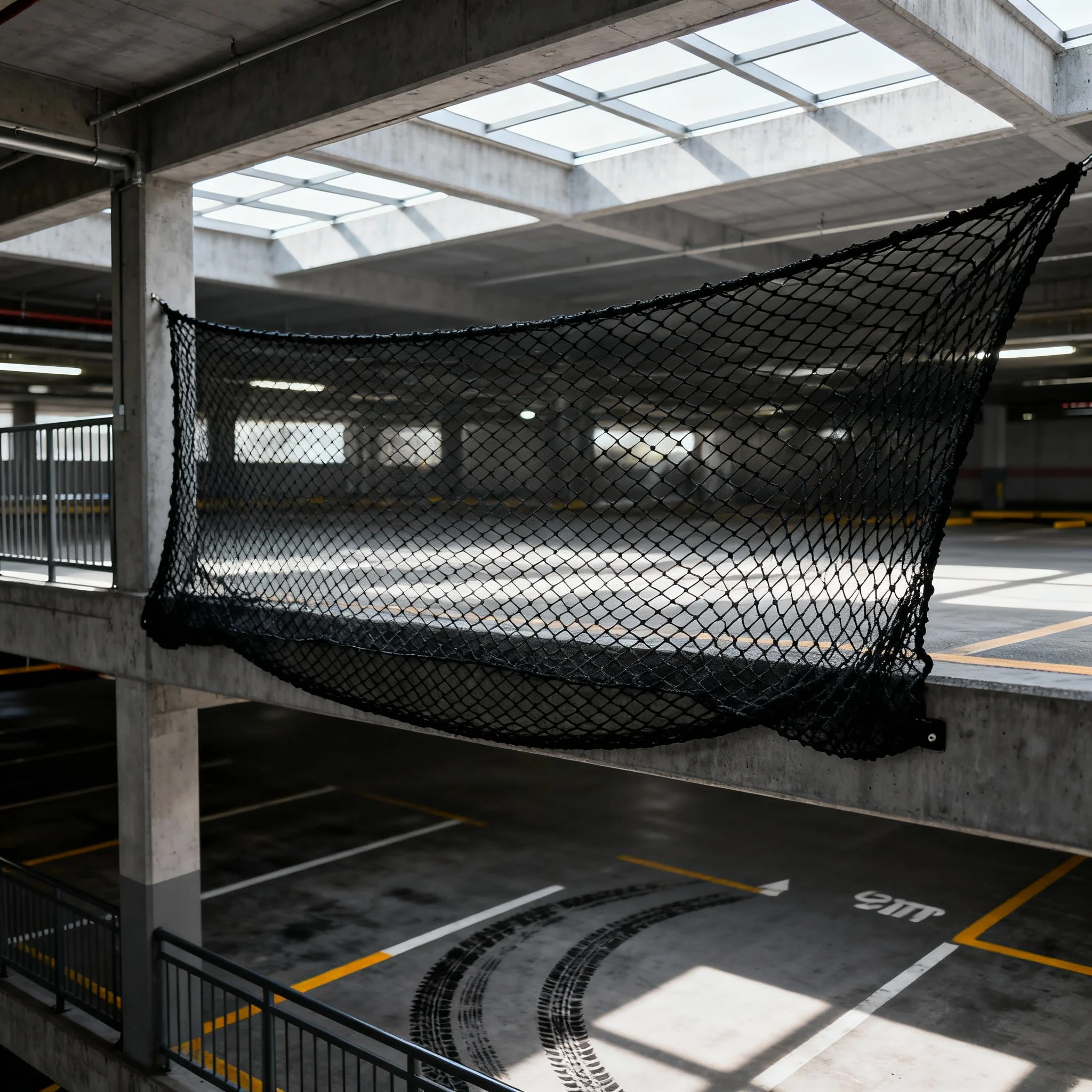
Measured netting for selected falling debris, bird entry or ball-containment risks around parking areas, with vehicle clearance and structural support checked first.
Business enquiries are open 24 hours, every day.
Site details before installation
A parking net cannot repair an unsafe slab, facade or tree. Loose concrete, glass or structural hazards require competent inspection and source repair.
Quick answer
One label can hide several different systems
Car parking net enquiries may involve light plaster flakes, leaves or small objects, bird access, sports balls from an adjacent play area, or open-sided fall risks. These are different problems and should not share a vague net specification.
Identify the source, likely size and energy of the object, protected zone, consequence of deflection, fixing structure and minimum vehicle clearance. For overhead installations, sag, lighting, sprinklers, signs, gates and maintenance access need careful coordination.
Netting is secondary protection for a defined, supportable hazard. Cracked concrete, loose facade panels, glazing, unstable trees or other dangerous sources should be isolated and assessed by the appropriate competent professional.
Common applications
Select a purpose-made system only after classifying the risk.
Temporary or secondary containment under a reviewed source, with inspection and clearance planning.
Around ceilings, pipes and defined entry routes without blocking building services.
Between play zones and parked vehicles using sport-specific mesh and supports.
Only a purpose-designed barrier compatible with guardrails and applicable safety requirements.
Commercial comparison
The hazard definition controls every later product decision.
Purchase intent
How the work is measured
Measure the protected footprint, overhead geometry, spans, cable lengths, anchors and safe access—not only parking-bay count.
Price changes with hazard, net system, support frame, height, traffic control and services. An occupied basement and an open surface lot need different installation plans.
Choose the right service
Service process
Identify the source and restrict affected bays when falling objects or unsafe building elements are suspected.
Map supports, spans, traffic, headroom, lights, sprinklers, pipes, gates and safe access.
Confirm net purpose, documentation, borders, cables, anchors, clearance and source-repair responsibility.
Control traffic, verify sag and access, then set inspections and captured-object removal procedures.
Before you approve the work
Local service
We handle enquiries across Bengaluru. Send your neighbourhood and site photos so access and measurement can be discussed before a visit.
Frequently asked questions
Cost depends on hazard, area, mesh, borders, cables, support frame, anchors, height, traffic control and service obstructions. A survey is needed for overhead work.
Do not rely on generic netting. Isolate the area and obtain competent building assessment and repair. Any temporary containment must be designed for the defined debris.
Heavy, concentrated impacts require specialist assessment and source management. Tree inspection, pruning or exclusion may be safer than assuming a light net will catch them.
Yes, for defined bird access routes, provided it does not obstruct sprinklers, lighting, ventilation, signs or maintenance and includes suitable access details.
It can. Design must allow for net sag, connections and captured material while preserving the required clearance along bays, ramps and gates.
A sport-specific ball-stop system may help when mesh, height, trajectory, impact, supports and side returns are properly planned.
The appropriate building or structural professional should assess questionable slabs, beams or frames. Installers should not treat weak finishes as approved supports.
Inspect anchors, cables, edges, sag and damage, especially after impacts or building work. Remove collected objects safely and keep services and headroom clear.
Send your location, full parking photos, approximate area and height, the object or animal to control, source photos, vehicle clearances, support details and nearby lighting, sprinklers, pipes, gates or ramps.
Open 24 hours, every day for enquiries.