Balcony entry gaps
Loose top edges, railing returns, wall junctions and corners used by pigeons.
Restore a complete bird-exclusion barrier
Pigeons can return through a surprisingly small missed corner, torn panel or gap around a pipe. Servani inspects the full exclusion boundary, active bird use, mesh, perimeter and access points before recommending a compatible repair, partial renewal or complete replacement.
Business enquiries are open 24 hours, every day.
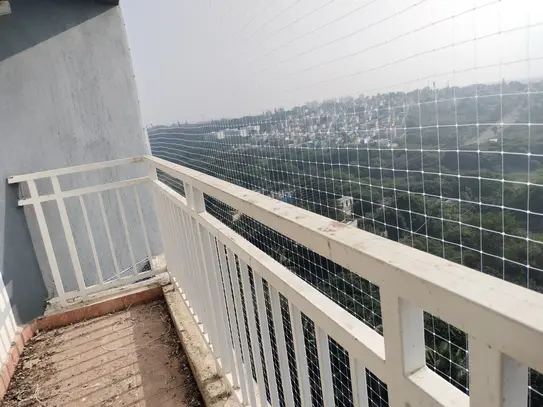
Site details before installation
A repair is successful only when every intended bird entry route is closed without trapping birds inside.
Quick answer
Find the entry route, not only the visible hole
A pigeon net works as an exclusion system. One loose upper corner, uncovered railing return, pipe gap or badly closed zipper can make a large intact panel ineffective. Repair therefore starts by tracing the complete boundary rather than patching the first visible tear.
Before any opening is closed, the area must be checked for birds, chicks and active nests. Humane exclusion means avoiding entrapment and planning cleaning, nest handling and closure in an appropriate sequence. Legal or wildlife guidance should be followed where protected birds or active nests may be involved.
When netting has hardened, faded or failed in several places, repeatedly adding small patches can create more snag points and hidden gaps. In that case a measured replacement with planned service access is often easier to inspect and maintain.
Common applications
Bird activity and the geometry of the enclosure help identify the true failure point.
Loose top edges, railing returns, wall junctions and corners used by pigeons.
Detached panels or service penetrations around pipes, drains and AC lines.
Zippers, overlaps or removable sections that no longer close without a gap.
Cuts, abrasion, weathering or previous patches that have opened or become hazardous.
Commercial comparison
Record how the repaired area will match the existing exclusion system.
Purchase intent
How the work is measured
Repair points, enclosed faces, access, cleaning interface and retained-net condition.
The lowest-cost patch is not useful if another corner remains open. Pricing reflects the work required to restore the defined exclusion boundary and any agreed access panel or replacement section.
Choose the right service
Service process
Share photos and explain where pigeons enter, sit or nest and whether birds are currently inside.
We check mesh, edges, corners, fixings, penetrations and required service access.
The repair or replacement sequence is agreed without knowingly trapping birds inside.
The defined gaps are closed, the enclosure is visually checked and maintenance guidance is provided.
Before you approve the work
Local service
We handle enquiries across Bengaluru. Send your neighbourhood and site photos so access and measurement can be discussed before a visit.
Frequently asked questions
A small isolated hole can often be repaired when the surrounding mesh remains sound. The full perimeter still needs checking because pigeons may be using another open corner or service gap.
Exclusion can fail through one upper corner, railing return, pipe opening, loose bottom edge or unclosed access panel. The entry route should be observed and the complete boundary inspected.
Price depends on the number and height of defects, retained-net condition, compatible mesh, perimeter work, access panels and whether a panel or whole enclosure needs replacement.
Yes when the mesh and fixings remain suitable. The cause of looseness—failed ties, anchor movement, cutting or material ageing—must be addressed before the edge is reclosed.
No bird should knowingly be trapped inside. Bird activity, chicks and active nests must be checked and a humane, legally appropriate closure sequence chosen before sealing the opening.
It may be possible when the old material remains serviceable and the new mesh and lacing are compatible. Brittle mesh can tear beside a strong new seam, making replacement preferable.
Cleaning is a separate scope and should be confirmed explicitly. Heavy contamination may require suitable protective procedures or a specialist cleaning provider before enclosure work.
A damaged zipper or access flap can be assessed. It must close without bird-sized edge gaps and remain easy enough for authorised maintenance staff to use correctly.
Plan a labelled zipper, overlap or removable service panel at the required location. After every service visit, the access opening must be fully reclosed and inspected.
Consider replacement when mesh is brittle, several edges have failed, patches are widespread, the original installation leaves many gaps or future service access cannot be made reliable.
Send your location, wide photos, close views of damage, suspected bird entry route, floor level, approximate installation age and whether birds or active nests are present.
Open 24 hours, every day for enquiries.